


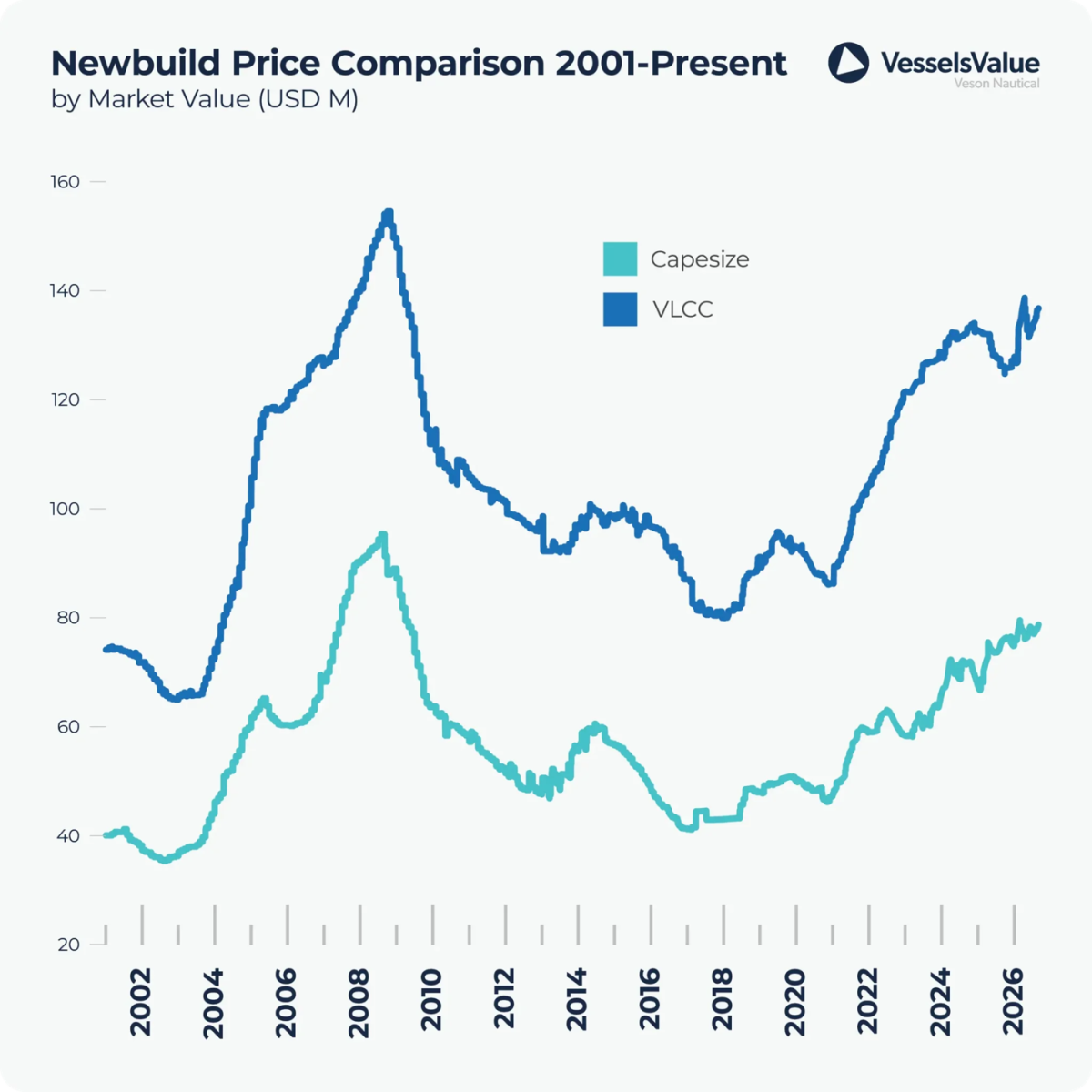
Newbuild vessel prices are once again approaching record levels, and the Asian shipyards with the fullest orderbooks stand to gain the most, according to a VesselsValue analysis shared with ANCONAV. The data points to a solid market across every monitored segment, for both newbuildings and second-hand tonnage.
According to VesselsValue – one of the largest consultants in the field – values currently sit at or very close to record levels. The analysis covers the evolution of newbuild and second-hand values, the type and location of orders, and the top five buyers of orders in Asia and the Middle East so far this year. The figures rely on VesselsValue’s fixed-age valuation methodology, which strips out natural depreciation; each number therefore reflects market movement alone, not simply a vessel growing one year older.
The comparison with 2004–2008 is telling: back then, the boom in commodities and cargo shipping ahead of the financial crisis – combined with constrained shipyard capacity – pushed prices to the previous comparable peak.
Top 5 Asian shipyards by on-order value
The ranking of Asia’s five leading shipyards is based on an updated snapshot of each yard’s on-order portfolio, valued at prevailing market prices. South Korea and China take every place in the top five, thanks to the production of large, high-value vessels such as VLCC tankers, LNG/LPG carriers and containerships.
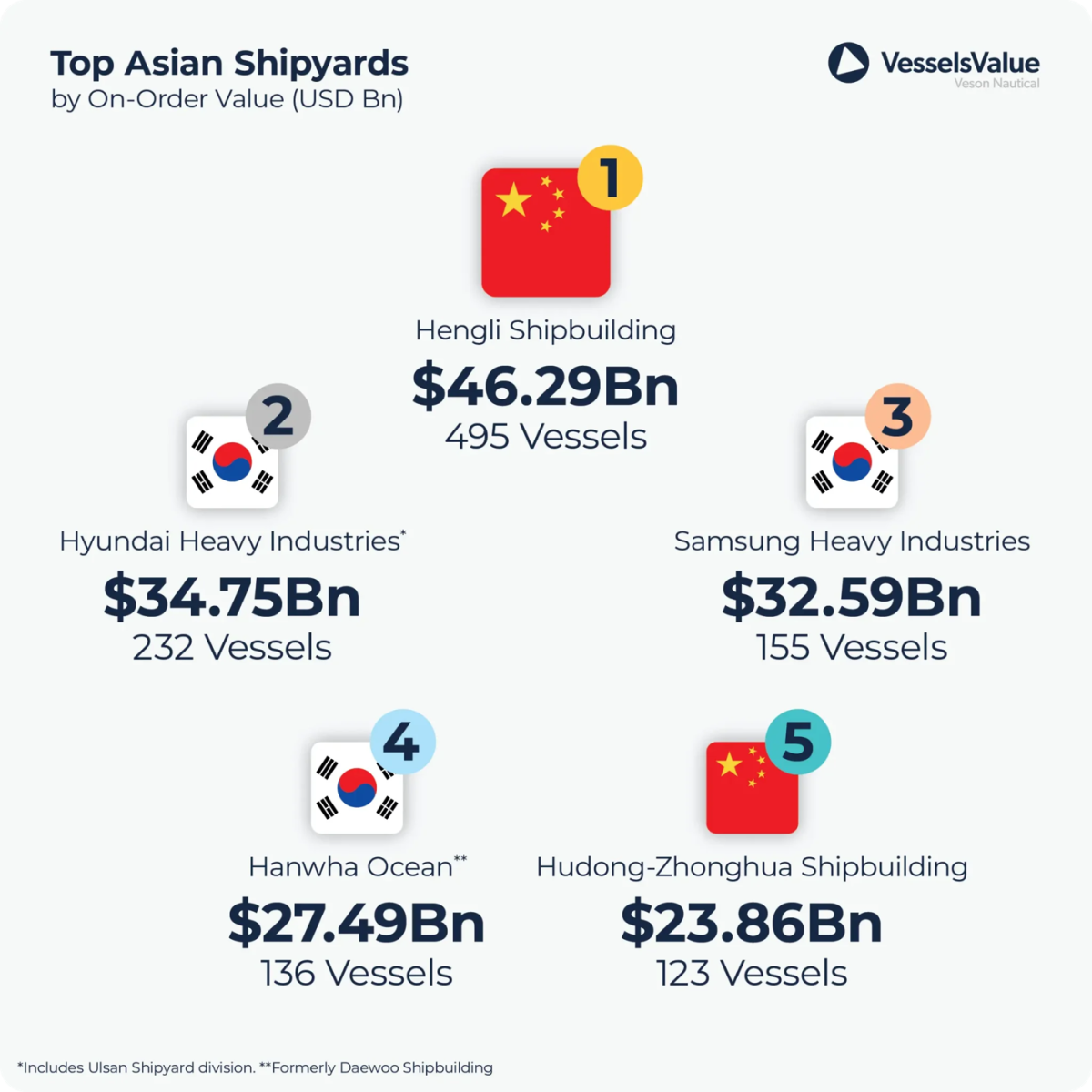
- Hengli Shipbuilding (China) – USD 46.29 billion, 495 vessels; a relatively new player that has taken first place on the sheer volume of activity, spanning bulkers, tankers and containerships.
- Hyundai Heavy Industries* (South Korea) – USD 34.75 billion, 232 vessels.
- Samsung Heavy Industries (South Korea) – USD 32.59 billion, 155 vessels.
- Hanwha Ocean** (South Korea) – USD 27.49 billion, 136 vessels.
- Hudong-Zhonghua Shipbuilding (China) – USD 23.86 billion, 123 vessels.
*Includes the Ulsan Shipyard division. **Formerly Daewoo Shipbuilding.
The next four yards hold smaller portfolios but with a higher unit value, focused on VLCC tankers, LNG/LPG carriers and containerships. Japan remains an important shipbuilding nation, but its yards specialise in niche vessels, which places them outside this particular ranking.
Top 5 buyers in Asia and the Middle East
On the demand side, Sinokor leads the top five buyers in Asia and the Middle East, with 74 vessels worth USD 6.16 billion, its fleet made up almost entirely of tankers.
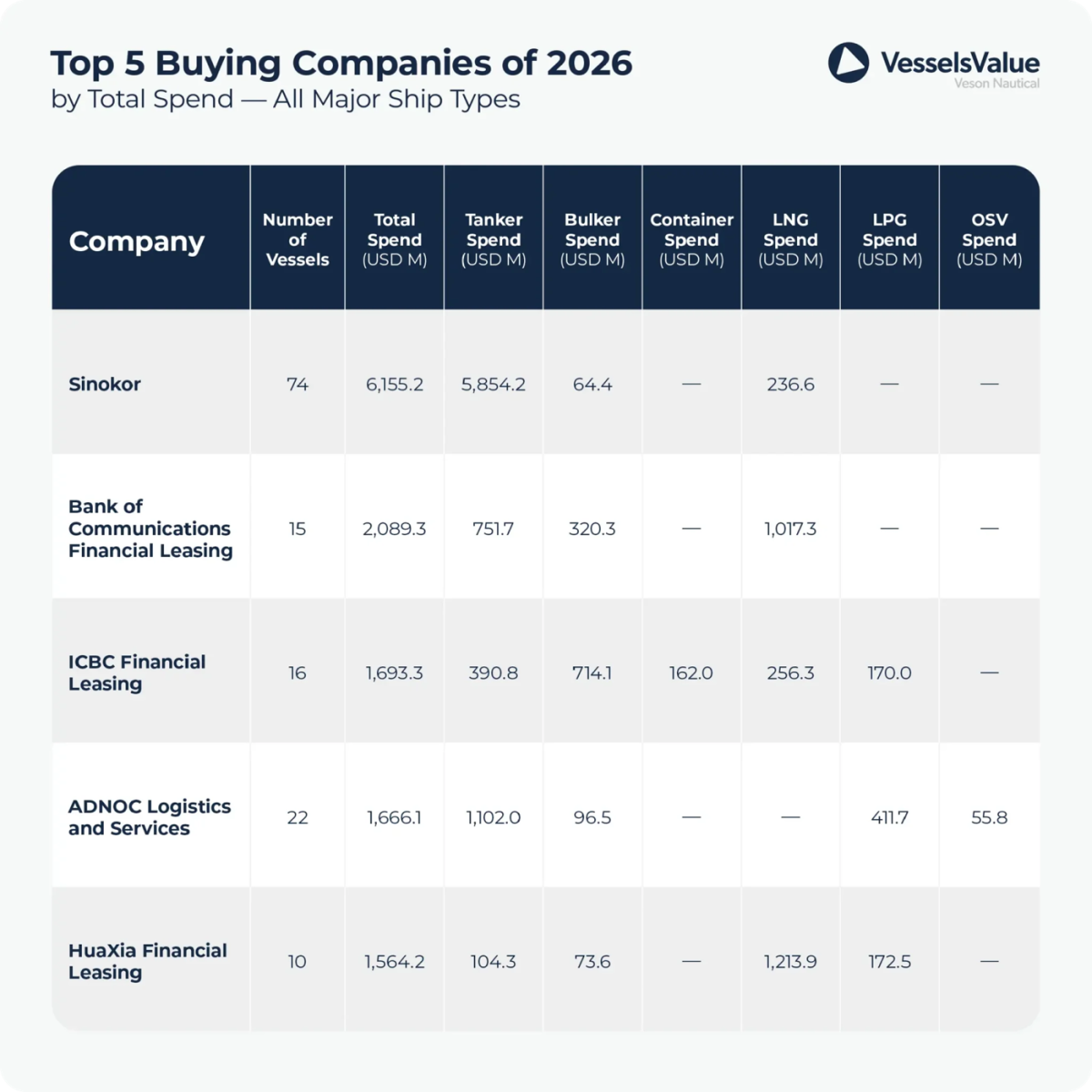
Three of the companies in this ranking – Bank of Communications Financial Leasing, ICBC Financial Leasing and HuaXia Financial Leasing – are Chinese leasing firms; together they account for USD 5.35 billion (41%) of the group’s spending, underscoring that a large share of orders in the region is now financed through leasing structures rather than direct ownership.
ADNOC Logistics and Services is the leading Middle East player, with 22 vessels worth USD 1.67 billion, its portfolio focused mainly on tankers and offshore support vessels (OSVs). Across the whole group of five buyers, newbuilding orders for tankers and LNG carriers account for more than 80% of total investment value, highlighting the dominant weight of these segments in today’s newbuilding market valuation.
What is driving prices
Several factors are behind this trend. Top Asian shipyards are carrying some of the fullest orderbooks in years, which limits the availability of construction slots and gives builders greater pricing power. At the same time, shipowners are racing to secure modern, fuel-efficient tonnage with dual-fuel propulsion ahead of tightening emissions rules; that trend adds further demand on top of the growing need to replace an ageing global fleet.
Prepared from VesselsValue information and charts shared by Gelu Stan (ANCONAV).